
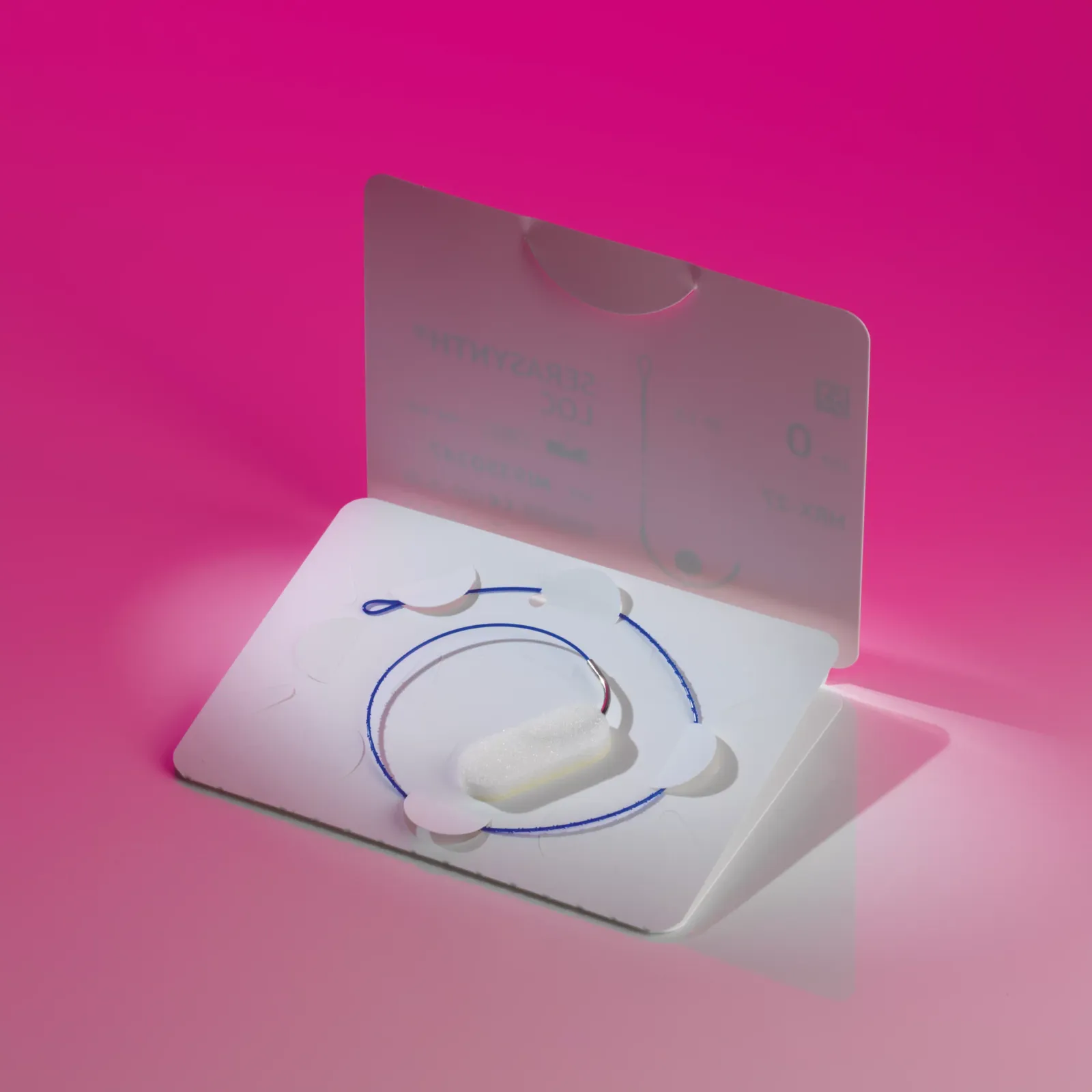
The underlying logic of surgical suturing has remained largely unchanged for centuries: approximate the tissue with a thread, then secure it with a knot. Over the past two decades, however, a material has become widespread that removes the "knot" from this equation — the barbed suture.
Barbed sutures carry microscopic projections, or barbs, cut into the thread at defined angles and intervals. These barbs allow the suture to advance freely in the direction of insertion while resisting movement in the opposite direction. The result is a suture line that anchors itself without knot tying.
How does it work?
In a conventional suture, tension concentrates at the knot points. With a barbed suture, each barb forms an independent anchoring point, distributing tension evenly along the suture line. This eliminates the risk of an entire closure failing because a single knot has slipped.
Two principal designs are used:
Unidirectional sutures. The barbs face a single direction. One end of the thread carries a loop or fixation element that anchors it to the tissue, and suturing proceeds in one direction.
Bidirectional sutures. Barbs are oriented in two opposing directions from the midpoint of the thread. Suturing begins at the centre of the wound and advances towards both ends, with each end anchoring itself.
The materials used are most commonly absorbable polymers (such as polyglyconate or polydioxanone derivatives), although non-absorbable versions are also available.
What advantages does it offer clinically?
Reduced operative time. Time savings can be substantial, particularly in settings where knot tying is technically demanding. Clear benefit in laparoscopic and robotic surgery. Intracorporeal knot tying within a confined working space is among the most time-consuming steps for the surgeon. Barbed sutures largely eliminate this step. More homogeneous tension distribution. Without knot bulk creating focal pressure points, anchoring along the suture line is more evenly balanced. Lower foreign material volume. The absence of knots slightly reduces the mass of material remaining in the tissue. Less reliance on an assistant. In most situations there is no need for a second hand to maintain thread tension as the suture is advanced.
Where is it used?
The range of applications for barbed sutures continues to expand. Prominent uses include:
Gynaecological surgery — vaginal cuff closure in laparoscopic hysterectomy, uterine repair in myomectomy Bariatric and general surgery — reinforcement of anastomoses, closure of mesenteric defects Urological surgery — urethrovesical anastomosis in robotic radical prostatectomy Orthopaedics — closure of deep tissue and joint capsule Plastic and reconstructive surgery — approximation of subcutaneous tissue, facelift procedures Abdominal wall closure — single-strand techniques in fascial closure
Points requiring attention
Barbed sutures are not a solution for every situation, and correct technique is essential:
Difficulty in reversing. Because the barbs anchor in one direction, withdrawing a misplaced stitch is not as straightforward as with a conventional suture. Planning the suture line in advance is therefore important.
Management of the free end. In intra-abdominal applications, an exposed thread end may rarely catch on bowel loops and lead to complications. Terminating the suture appropriately and trimming any excess is a critical step.
Tissue selection. In very thin, fragile or markedly inflamed tissue, barb anchoring may not perform as expected.
Learning curve. The material behaves differently from conventional sutures; applying appropriate tension and terminating the suture correctly require practice.
Cost. The unit price is higher than that of conventional sutures. However, when reduced operating room time is taken into account, total cost analysis may yield a different picture — an assessment that varies from centre to centre.
Conclusion
With the growth of minimally invasive surgery, barbed sutures have moved beyond being an alternative material and have become a routine option in many centres. Used for the right indication and with the right technique, they offer the surgeon time and the tissue a more balanced distribution of tension. Weighing their strengths alongside their limitations, they represent a valuable addition to the surgical team's available options.
About 7Medikal
In the field of surgical sutures and medical textiles, we bring quality solutions to healthcare professionals across Türkiye. Please contact us for information about our product portfolio and training programmes.
This article is provided for general information purposes only and does not constitute medical advice or product instructions for use. Suture selection and application technique are specific to the patient and the surgical indication. For definitive information on product use, please refer to the manufacturer's official instructions for use.